What would be your best guess if I asked you “what is the most important element in getting people to create top level work”?
I am curious because I recently read about a multi million dollar study that Google did to find out what made the most productive and successful work teams.
What they found might surprise you. It surprised Google. They previously thought talent was the most important ingredient in the success cake and it was something they’d spent a lot of money on. But what they found was most critical in teams that produced the best work was: Wait for it. Psychological safety. I didn’t guess that but when I heard the answer it seemed a lot like common sense.
When do we do our best work, our best thinking, have our best relationships, have the most fun? When we are relaxed and our authentic selves, when we can play and explore and don’t worry if we appear silly and dumb or judged.
And that got me thinking about the last five years and the world we live in right now and all of us humans that don’t work for Google. If psychological safety in the workplace is critical to the bottom line what does the feeling of psychological safety do for all humans as we live our lives? What’s our bottom line? Our health? Our happiness? Our personal success?
And my second question to you is how psychologically safe do you feel?
For many of us 2020 marked a sharp decline in psychological safety. It was a traumatic, rude awakening for many. The media has always lived by the rule “if it bleeds, it leads” but 2020 gave them more blood than they could ever hope for, some real, some imagined.
And of course the divisiveness that has grown around vaccines and elections has become louder than a million cicadas in a Texas summer. Some people are afraid to share what they really believe with their friends and neighbours. How does that impact our feelings of safety when we can’t speak our mind? When we might be cancelled? And how does it make us feel when some people can’t wait to angrily wave their thoughts in our faces.
Sometimes it feels like fear and lack is some sort of currency that the world trades on. Social media employs it against it’s users. Teenage girls that remove photos of themselves from social media are served beauty advertisements. Advertising is always searching for our pain points.
In Canada we recently elected a government by a narrow margin based on fear of Donald Trump. Some people’s perceived lack of safety was used as a motivating factor.
I don’t mean to depress you but sometimes the first step to seeing in the dark is to turn on the lights. What are those things that make you personally feel unsafe? Is it those subtle feelings of agitation as you scroll content on social media? That will do it for me.
Is it listening to the news, the talk of the next pandemic, of war, of financial doom and gloom? Each one of us will have our own very personal triggers.
Once we have explored the things that make us feel unsafe we can ask: what can we do to create our own psychological safety? Can we evaluate the source of information that is making us feel unsafe? Is it true? Does the person or group sharing the information have a vested interest in making us feel afraid? We can use our own trusted sources to do research and rely on our gut feelings about the situation. For me something felt very off when they shut down the whole world in a minute. For another person I know it was when every news outlet and government was using the exact same words to talk about what was going on.
As an artist one of the ways I create psychological safety is by turning off all the outside noise and steeping myself in some creative activity. When I paint my attention is absorbed, worry melts away and my focus is concentrated on the task at hand. What activity or hobby absorbs your attention completely? That’s a way to take a break from the noise and regain your own sense of balance and feelings of psychological safety.
Many of us turn to the great outdoors to drink in the healing sustenance of nature. To feel the energy of the forest or a park, or take a simple stroll around the neighbourhood can offer solace and comfort to our minds and bodies. Lie in the grass or put bare feet on the ground to absorb the magnetic and healing energy of the earth.
Because we spend so much time indoors it’s important to create personal sanctuaries in our home and office spaces. Clear clutter and bring in things that are meaningful to decorate the space. Do you love a calming, light filled room with a minimalist vibe? Or a warm, cozy nest filled with inherited treasures and walls painted in a deep hue? Does a collection of stones from the beach call up relaxing memories of waves touching the shore? Perhaps photos of travels with friends makes you feel the warmth of community?
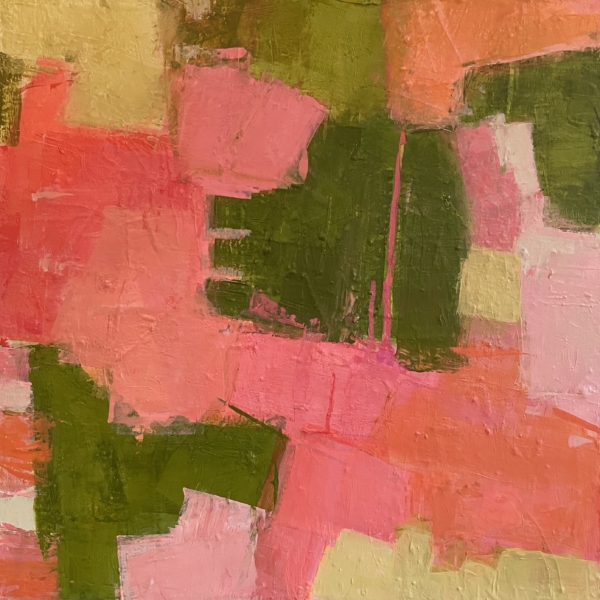
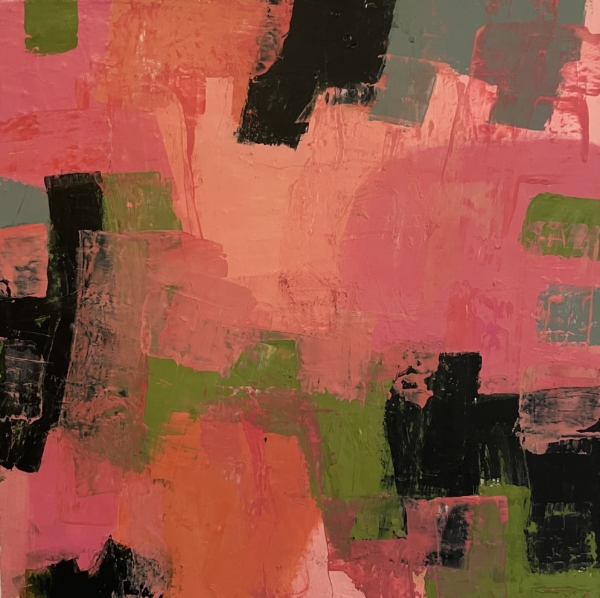
As an artist I strongly believe that the art you hang on your walls can create feelings of calm that contribute to your psychological safety. I know that in my bones. I have experienced it.
Think of your space with bare walls, no art. How does it feel? And then imagine your room with art that you have intentionally chosen to create a peaceful sanctuary. Maybe you gravitate to soft pink work with flowing lines or maybe you choose a painting that reminds you of a walk in the forest. Creating spaces with intention can infuse your world with an energy that makes you feel safe. Do you believe art has that power? Do you believe you have that power?
I know that we have more power than we have been led to believe. We are the creators of many things including our own psychological safety. And with that power we can create refuges that promote the energy of calmness, relaxation and safety that protect us from the storms of the outside world.
Wishing you a week of powerful creative exploration.
